
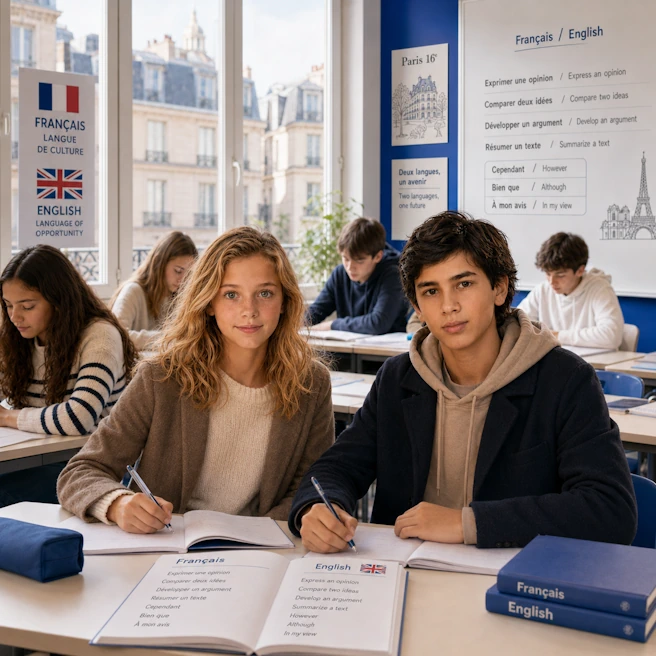
At Ipécom Paris, bilingual education is built within a clear academic framework: regular practice of English, exposure to anglophone culture, oral projects and selected subjects approached partly in English. Students keep the structure of the French curriculum while developing greater fluency, vocabulary and confidence. This track is designed for families looking for a small, attentive and internationally minded private middle school in Paris.
Key facts about the bilingual middle school track at Ipécom Paris
| Track | French-English bilingual option within the middle school curriculum. |
| Levels | From 6e to 3e, depending on the student’s profile and the school’s educational assessment. |
| Main objective | To strengthen oral, written and cultural English while preserving the foundations of the French curriculum. |
| Student profile | Curious, motivated students, pupils comfortable with languages, or children who need a more stimulating academic environment, including some high-potential learners. |
| Organisation | Enhanced English, literature, oral expression, projects and selected subjects worked on partly in English depending on the level. |
| Educational setting | Small groups, individual attention, regular speaking practice and progressive academic expectations. |
| Location | Ipécom Paris, 8 rue Benjamin Godard, 75116 Paris, near the Mairie du 16e and Avenue Victor Hugo. |
| Access | Paris 16th, Neuilly-sur-Seine, Boulogne-Billancourt, Suresnes, Courbevoie and Levallois-Perret. |
Bilingual middle school, bilingual school or English-speaking school: what is the difference?
Families do not always use the same words when looking for the right school: bilingual middle school in Paris, private bilingual school in France, English-speaking school or French-English school. These expressions are close, but they do not always refer to the same type of education.
At Ipécom Paris, the French-English bilingual track follows a clear principle: to increase exposure to English without separating students from the French academic framework. English is used as a language of communication, culture and reasoning, while school life remains structured around the expectations of the French middle school curriculum.
This approach suits families who want a more internationally open environment than a traditional middle school, without necessarily choosing full immersion or a fully international school. The goal is to build a strong, gradual and realistic progression, compatible with further schooling in France or abroad.
A bilingual middle school in Paris 16th, combining French academic standards and anglophone culture
Middle school is a decisive stage in a child’s education. Students enter secondary education, gain autonomy, adapt to a new pace and progressively develop their study methods. In this context, a well-designed bilingual track can become a powerful lever for academic and personal growth.
At Ipécom Paris, the French-English bilingual option is not simply a matter of adding extra English lessons. It aims to establish regular language practice, develop confidence in speaking, broaden general culture and prepare students for the expectations of high school.
The track remains clearly rooted in the French curriculum while opening students to anglophone references, methods and communication situations. The objective is to help middle school students become more confident, more autonomous and better prepared for an academic and cultural environment with an international dimension.
A French-English bilingual pathway from 6e to 3e
The bilingual option supports students throughout middle school, from 6e to 3e. Progression is designed to take into account each student’s actual level, consolidate foundations, develop language habits and make English a language for work, communication and reflection.
In 6e and 5e, students consolidate vocabulary, sentence structures and listening comprehension. They learn to speak more often in a supportive but demanding setting. In 4e and 3e, the work becomes more advanced: text comprehension, structured expression, anglophone culture, oral projects and gradual preparation for high school expectations.
| Level | Main objective | Skills developed |
|---|---|---|
| 6e | Build confidence and foundations | Listening comprehension, everyday vocabulary, short speaking tasks and classroom routines in English. |
| 5e | Gain fluency | More spontaneous speaking, guided reading, short projects and cultural or scientific vocabulary. |
| 4e | Structure expression | Simple argumentation, presentations, document comprehension and richer grammar and vocabulary. |
| 3e | Prepare for the next stage | More autonomous expression, anglophone culture, method, oral work and preparation for demanding high school pathways. |
Why choose a bilingual middle school in Paris?
A bilingual middle school helps students move beyond a purely academic approach to English. The language becomes a tool to understand, research, present, read, debate and create. This regular practice is especially valuable at middle school age, when confidence in speaking can either develop or become blocked.
Speaking English more often
Progress in English depends greatly on the frequency of practice. In a small-group setting, each student can speak more often, receive more precise feedback and gradually gain confidence.
Understanding another culture
The bilingual option is not limited to grammar. Students discover texts, cultural references, communication situations and different ways of approaching knowledge. This openness develops curiosity, listening skills and the ability to consider different points of view.
Preparing for high school and international pathways
A strong level of English is an advantage for the rest of a student’s education: general high school, language-related subjects, European or international sections, certifications, higher education and mobility. The bilingual option gives students a methodical head start without locking them into one single pathway.
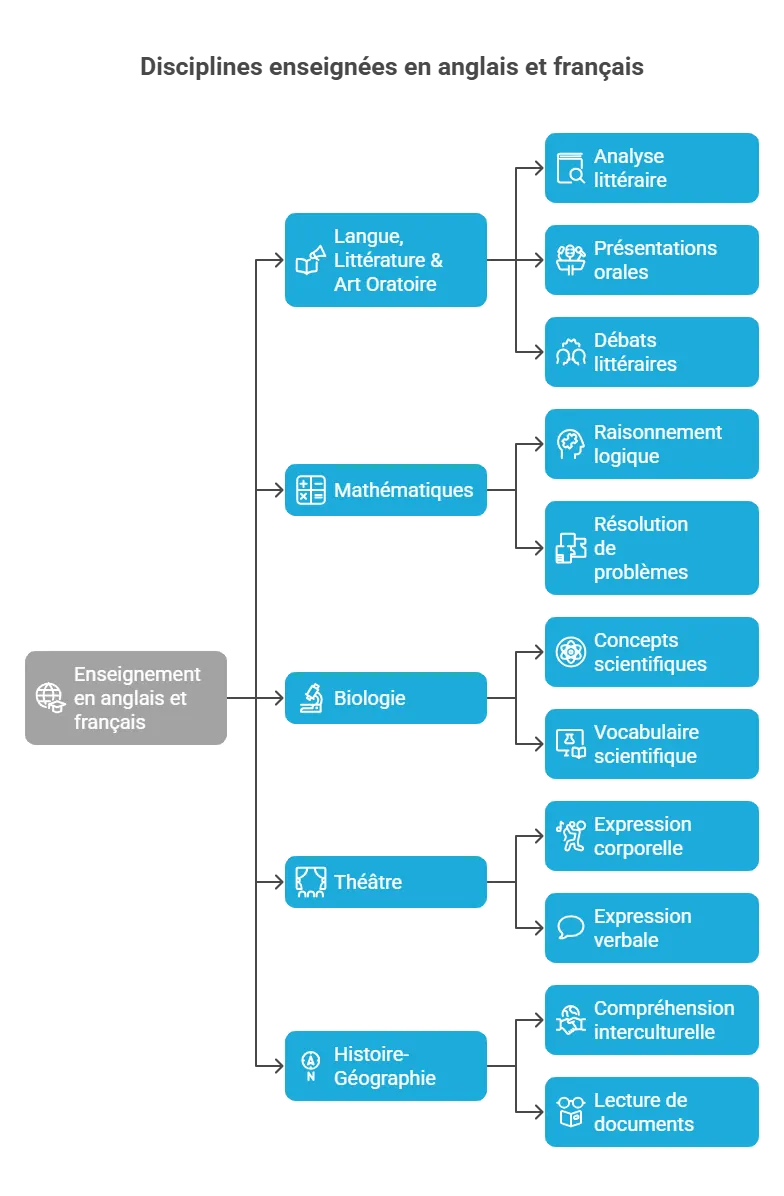
Subjects and activities worked on in English
At Ipécom, English is developed through several formats: language classes, literature, oral expression, projects, workshops and selected subjects partly approached in English depending on the level. This diversity strengthens language skills while giving meaning to learning.
Language, literature and public speaking
- Reading and studying classic or contemporary texts adapted to the students’ level.
- Work on comprehension, written expression and vocabulary.
- Oral presentations, short debates and structured speaking tasks.
- Progressive discovery of anglophone cultural references.
Mathematics in English
Mathematics may be worked on partly in English, especially through the vocabulary of instructions, logical reasoning, problem-solving and justification. The objective is not to replace the French curriculum, but to help students handle familiar concepts in another language.
Biology and scientific vocabulary
Some scientific topics can be approached in English: ecosystems, cells, nutrition, the environment, observation or the description of phenomena. Students enrich their scientific vocabulary and learn to explain simple concepts in a foreign language.
Theatre and oral expression
Theatre in English helps students work on pronunciation, memory, presence, listening and confidence. It is an effective tool for pupils who need to make the language more lively and less purely academic.
History-geography and anglophone culture
History and geography may be enriched through documents, maps, texts or resources in English. Students learn to read sources, compare viewpoints and understand different cultural realities.
A bilingual option for curious, motivated or high-potential students
The bilingual option is particularly suitable for students who enjoy understanding, exploring, reading, debating or expressing themselves in different ways. It may also meet the needs of some high-potential learners, who often benefit from a more stimulating, active and culturally open environment.
At Ipécom, the aim is not simply to add more English hours. The goal is to create an environment in which students can gain precision, confidence and autonomy. Small groups make oral participation, progress monitoring and individual adaptation easier.
This track is part of Ipécom’s broader middle school approach: individual support, attention to student profiles, progressive academic expectations and serious preparation for the next stage of schooling.
Families may also consult our pages dedicated to high-potential students, the Classe Flash and the Classe Éclair.
What level of English can students aim for by the end of middle school?
By the end of middle school, the expected objective for the first foreign language is to progress towards level B1 of the Common European Framework of Reference for Languages. Ipécom’s bilingual option therefore aims for a solid, regular and realistic progression, adapted to each student’s starting level.
Some students may go further depending on their profile, exposure to English and personal work. But the priority remains clear: understanding, speaking, reading, writing and arguing with greater ease, without creating an artificial or uniform promise for all pupils.
This approach naturally prepares students for high school, English-related subjects, European or international sections, language certifications and study projects with an international dimension.
Small groups: a decisive setting for oral progress
In language learning, group size makes a real difference. A student may know grammar rules and still feel blocked when speaking if they do not practise enough. At Ipécom, small groups make it possible to increase speaking opportunities, interaction, correction and personalised encouragement.
This setting also helps teachers identify needs more precisely: lack of vocabulary, pronunciation difficulties, fear of making mistakes, fragile comprehension or written expression that needs structuring. Progress becomes more concrete, more visible and better adapted to each student.
A bilingual track compatible with the French curriculum and the brevet
The bilingual option enriches the student’s education without moving them away from the fundamental expectations of the French middle school system. Students continue to work on essential subjects, study methods, written expression, mathematics, science, history-geography and preparation for the diplôme national du brevet.
This balance matters: a strong bilingual pathway should not be built at the expense of academic foundations. It should strengthen rigour, curiosity, autonomy and the ability to learn in several contexts.
After 3e: high school, international pathways and continuation at Ipécom
At the end of middle school, students have a stronger foundation in English, greater oral confidence and a broader general culture. They may continue their education at Ipécom Paris high school or join other schools depending on their project, level and profile.
The bilingual option is an asset for students considering demanding pathways: literary or scientific subjects, European or international sections, English certifications, higher education in France or abroad.

Family reviews about Ipécom Paris middle school
Family reviews give a more concrete view of the Ipécom middle school experience: small groups, individual attention, academic confidence, oral participation and dialogue with the educational team.
Une équipe bienveillante et efficace
Excellente école. Les professeurs sont très gentils et savent comment s’occuper d’un enfant lorsqu’il a beaucoup de difficultés. Cette école a beaucoup de stratégies.
Merci

Classe double 6/5è à effectif contenu, c’est appréciable
Classe double 6/5è à effectif contenu, c’est appréciable. Enseignement ambitieux qui encourage la réussite notamment par le biais de l’acquisition de méthodologies de travail. Équipe dirigeante expérimentée, bienveillante accessible et attentive, tout particulièrement Madame Reithmann (directrice) et M. Coignard (cpe) qui sont formidables.

Reconnaissance sincère et pérenne aux professeurs et à l’encadrement
Je souhaite ici déposer quelques mots, comme on adresse une reconnaissance sincère et pérenne aux professeurs et à l’encadrement administratif d’Ipecom. Quelques lignes qui sont somme toute banales, mais qui sont un encouragement destiné aux élèves et parents qui cherchent des informations sur cette école, à la confiance que l’on peut lui accorder, pour y rencontrer des femmes et des hommes qui ne sont pas que des techniciens d’une immense compétence, pris dans leurs rôles d’enseignement ou d’encadrement, mais qui par la générosité de leur intelligence et de leur cœur donnent une chance réelle, et ouvrent des perspectives culturelles et humaines à nos enfants. Merci encore et bravo à toute l’équipe.

Bilingual middle school in Paris 16th: location and access
Ipécom Paris is located at 8 rue Benjamin Godard, 75116 Paris, near the Mairie du 16e and Avenue Victor Hugo.
The school is easily accessible from Paris 16th, Neuilly-sur-Seine, Boulogne-Billancourt, Suresnes, Courbevoie and Levallois-Perret.
- Metro line 9: Rue de la Pompe;
- Metro line 2: Porte Dauphine;
- RER C: Avenue Henri-Martin;
- Bus lines 63 and 82, depending on the route.
Ipécom is a day school.
Admission to the bilingual middle school track at Ipécom Paris
Admission to the bilingual option is based on the student’s file, an exchange with the family and an assessment of the student’s profile. Depending on the situation, an English level assessment may be proposed to check whether the track matches the student’s needs and abilities.
The right choice is not only a question of language level. Motivation, curiosity, autonomy, confidence in speaking and the student’s need for support must also be taken into account.
For further information, please contact Ipécom Paris by phone at +33 1 47 27 00 50 or by email at contact@ipecomparis.com.
FAQ – Bilingual middle school in Paris
What is a French-English bilingual middle school?
A French-English bilingual middle school offers enhanced English teaching and activities or subjects partly worked on in English. The aim is to develop language confidence, cultural understanding and oral fluency while preserving the structure of the French curriculum.
Is the bilingual option at Ipécom open from 6e to 3e?
Yes. The bilingual option concerns middle school students from 6e to 3e, depending on their profile, level and the school’s educational assessment.
How many hours are worked on in English each week?
The number of hours may vary depending on the level and the organisation of the school year. Exposure to English includes language classes, oral activities, literature, projects and selected subjects partly worked on in English.
Is the bilingual track compatible with the brevet?
Yes. The bilingual option enriches the student’s education without replacing the core learning requirements of the French middle school system. Students continue to prepare for the expectations of the diplôme national du brevet.
What level of English can students aim for by the end of middle school?
For the first foreign language, the end-of-middle-school objective is to progress towards level B1 of the CEFR. The bilingual option helps students consolidate comprehension, oral expression and written expression, with progress adapted to their starting level.
Is the bilingual option suitable for high-potential students?
It may suit some high-potential students, especially when they need a more stimulating, active and culturally open setting. Admission depends on the student’s overall profile, motivation and support needs.
Is Ipécom located in Paris 16th?
Yes. Ipécom Paris is located at 8 rue Benjamin Godard, 75116 Paris, near the Mairie du 16e and Avenue Victor Hugo. The school is accessible from Paris, Neuilly-sur-Seine, Boulogne-Billancourt, Suresnes, Courbevoie and Levallois-Perret.
Explore Ipécom’s educational approach

L'Excellence en culture anglo-saxonne pour une Ouverture Internationale

Confiance en soi et plaisir d’apprendre
Pourquoi nous sommes un des meilleurs

Pourquoi choisir le hors contrat ?

L’Accompagnement Pédagogique Personnalisé

Dialogue actif avec les parents

Tisser des Liens pour Apprendre : La Relation Dynamique Élève-Enseignant

Les avantages des classes à effectif réduit
Our articles on bilingual education

Innovation - Le Théâtre dans l'Éducation
École à double maîtrise linguistique

Réussir au collège bilingue 🇫🇷 🇬🇧
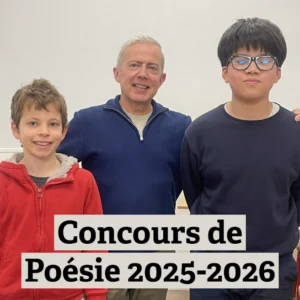
Remise de Prix du Concours de Poésie 2025-2026

Concours de Poésie 2024 : L'Art du Verbe et de la Performance
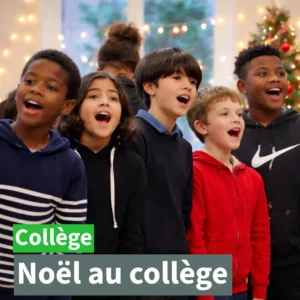
Noël au collège Ipécom

Apprendre avec les outils d’aujourd’hui

Un Regard sur le Concours de Cento
Learn more about our school





Mis à jour le 21 Juin 2026 à 13:02
Accès rapide
Tous les parcours Ipécom, du collège à la prépa.